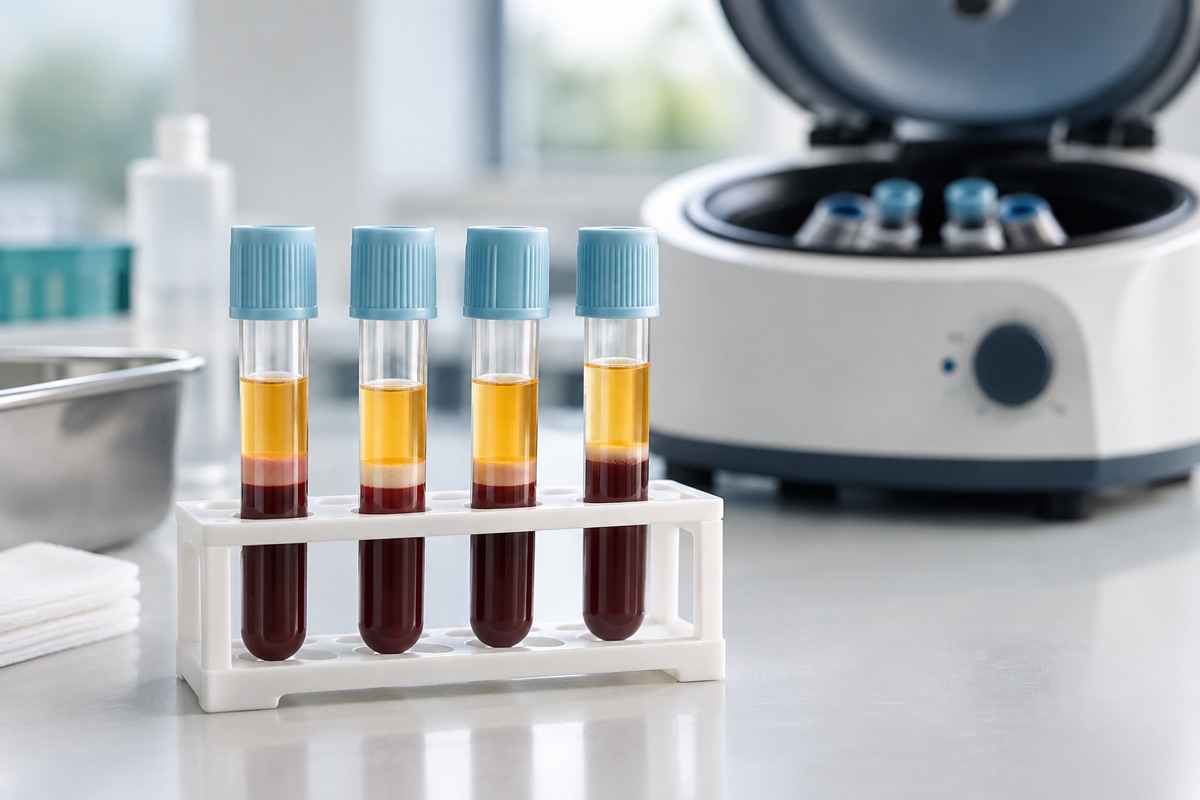
PRP concentrates platelets from your blood. Some trials and pooled analyses show symptom improvement, while the rigorous RESTORE trial did not find a significant pain or cartilage-volume benefit at one year. [1][2][3][4][5]
02
Who might it suit?
For: Mild–moderate knee OA only, after clinician agreement.
Not for: Routine use in advanced or bone-on-bone arthritis. Hip cases need review.
03
Limits and important cautions
Protocols differ, and advanced hip or knee arthritis is not the same population as mild-to-moderate knee OA. Relief should not be described as proven cartilage regrowth.
What happens, how long, and what could it cost?
What happens
Blood is collected and processed to concentrate platelets, then the preparation is injected.
When might I notice a change?
A reliable personal timeline cannot be predicted from the evidence reviewed here. Agree on a review date before starting.
How long might benefit last?
Benefit and durability depend on the exact intervention and population. The evidence section below explains what is known.
Repeat treatment
There is no single universal PRP preparation or repeat schedule. Ask what supports the proposed course.
Activity and recovery
Ask who provides follow-up, what symptoms need urgent attention, and what restrictions apply to you.
Ask for a complete estimate
Preparation, number of injections, imaging guidance, follow-up, and rehabilitation.
Use this as a consultation guide. A timeline is not a guarantee; the evidence and FDA sections below remain part of the decision.
Reports functional benefit for both leukocyte-rich and leukocyte-poor PRP at 6–12 months. Indirect comparisons and differing protocols limit generalization.
In 288 people with mild-to-moderate knee OA, the tested PRP protocol did not significantly improve pain or cartilage volume at 12 months versus saline.
Knee-specific guidance; evidence strength varies by treatment. It should not be applied automatically to hip disease.
Editorial synthesis · reviewed September 19, 2026. These are selected decision-relevant references, not an exhaustive systematic review or a new formal evidence grade. FDA status and coverage are assessed separately.
FDA status
Preparation clearance ≠ OA approval
FDA clearance of a PRP preparation system does not establish approval of PRP injections for osteoarthritis. For example, FDA’s ORG classification covers preparation for mixing with bone graft to improve handling. The exact device and intended use must be checked; no cartilage-regrowth approval is claimed here.
Site summary of FDA information · reviewed September 19, 2026. Refer to current product labeling. This is not an FDA endorsement of this site.What do professional guidelines say?
AAHKS: Does not recommend routine PRP for advanced hip or knee OA. Limited evidence suggests benefit over placebo or gel in mild–moderate knee OA.
ACR: Strongly recommends against PRP for knee and hip OA.
Will Medicare cover it?
OA PRP is generally not covered. Plan for cash if a clinician agrees.
Compare nonsurgical knee arthritis care, injection choices, and selected surgical alternatives—with evidence, limits, and questions for your clinician.